LANGUAGE THROUGH BLACK FORCE
CONTEXT & DUTY

I. BLACK FORCES
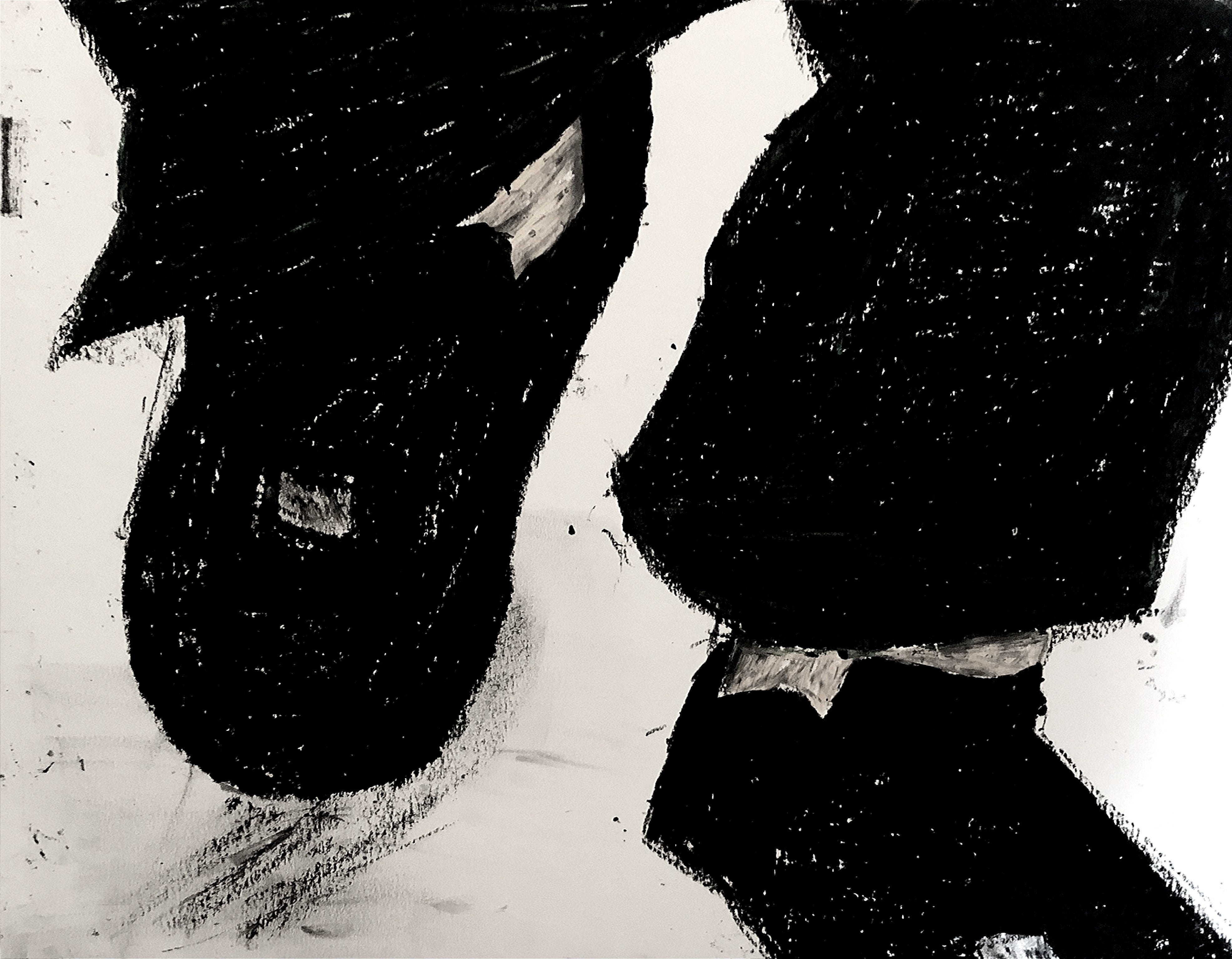
I had someone ask me last year, “when did the black air forces appear” in my artwork. During the pandemic there were so many people robbing different places, I came across this video of this man: he had on a black hoodie, black pants, which I assumed to be dickies, white socks, and jet-black, Air Force ones on. Cradled in his arms, he held a box of shoes as he was running out of the storefront.
At the moment, all I could think was— that is the energy. Ever since then, I have been working on encapsulating that energy of not only, what the shoe has come to symbolize through the social-culture of blackness; the slime, the theft, the power, the harm, the chaos, the menace, the shade, the shadow, the darkness, the forces, but also, the metaphoric dance of black forces.
This is when it appeared in my word-building.
After the initial thought iterations, I painted a sketch-drawing, which I think I still have… or someone has collected it. I have become obsessed with drawing the shoes activated in their agency of running. Appearing over and over again, the black forces showed up as obsessively as the word “nigga” appeared in my work. There’s not a moment where I’m making work where I’m not thinking about that energy— that I am not inputting myself into the black force canon– I have made it my duty.
II. NIGGA
I have no idea when the word nigga appeared in my work.
I do know when I was questioned about it for the first time, I was confused because no one had ever questioned why I used the N-word, why I said “nigga”, or why I would use any variation of the word negro or nigger… because, amongst the people that I was around, it was something that just existed. Not to deny that you cannot question what already exists, I just had never experienced being questioned about it. Asking a post-modern Black American when they began using with word, “nigga,” could be answered in the same regard Vince Staples responded to Charlemagne when asked, “have you really never fell in love with Hip-Hop?…
When conservatives and white folks-alike question my use for social-cultural things I have collected and embedded as part of my DNA, I reckon I get a bit defensive. Their offense has an air of entitlement, as though they are the final policy holders of how theBlack-American way of being evolves.
They were offended.
I sat down in my studio and asked myself why I was using it, and I came to a realization… that I use “nigga” in my work consistently and constantly because I am obsessed with context. I am obsessed with how much context matters and how often it is overlooked when it comes to Black people deciding to highlight an alternative use; when I shift context it shifts meaning.
Whenever I observed the word “nigga” appear in other peoples work, whether it be through galleries or museums, or even in text, “nigga” was always highlighted in the ways in which it appeared negatively: socially, culturally, economically, psychologically, and so forth projected onto the Black American. Within institutions, this has been the only way that I had seen it accepted and validated. My aversion to this political play is that although necessary in the historical context of happenings, it removes agency from the possibility and mere existence of the word “nigga” being agitated with Black Power— when isolated to the perpetuations of white systems of domination.
The timeline highlight of the evolution of the word “niger” and “negro” translating to “black” has already been mastered. I do not feel the need to go back 500 to 600 years, in order to re-observe the word in a context that I am not necessarily interested in. If somebody has already done it, it gives me the perfect opportunity to cannon from the platform that they’ve already developed and designed (for me).
The term can be used positively, and has been used positively (before I was even born). I can see the complex ways in which “nigga” has evolved linguistically through the Black American culture of English. My lexical analysis of the Black-American-English includes observing the contextual evolution of the term “nigga”. It also highlights that “nigga” is not isolated to blackness. I’ve noticed that Black Americans for example, could say “them “niggas” over there trippin’,” and it could be a circle of white folks— I could say, “damn that nigga barkin’ hella loud this morning,” and it could be the dog next-door. And so, when I consider the myriad of ways in which it shows up, it is too complex for me to isolate “nigga” to the one way a person receives it due to their personal backgrounds and experiences with the language.
“Nigga” proves itself as an opportunity for me to collect how people are affected, or not affected by the word. This is a part of my cannon of the Black Forces. The Black Air Force 1’s opened up a portal for me to explore language, as well as, cultural and social projections.